Marsen Insight Vol 3: Why is looking beyond a seafarer’s CV is important?

On paper, many seafarers may look qualified. The common baseline to judge competence are seen through certificates, years of sea service, and training records. But these documents don’t always reflect a seafarer’s current technical capabilities or soft skills. 

For shipowners and operators, what truly important is assigning the right seafarers on the right vessel. Beyond CVs, certificates and documented training, this means ensuring: 

  1. Relevant vessel experience.
  2. Effective teamwork in a multinational crew environment. 
  3. Maritime English and Standard Marine Communication Phrases (SMCP)
  4. Cultural adaptability and leadership ability. 

These qualities directly impact both safety and performance.

Certificates are not enough

Yes, certificates verify eligibility. But, they don’t always measure applied competence. A seafarer may hold an advanced training certificate for Tankers, for instance. However, a seafarer may remain struggle when operating under a real-world time pressure or emergency, due to language barriers.

Human Factor: Communication and teamwork

Technical knowledge is crucial, but not enough. A recent study by Hafita et al. (2024) from a Journal of English Education shows that while cadets and seafarers often receive language instructions, many still lack the ability to communicate clearly in emergencies or technical context. This is a risk, especially when working in a multinational environment. The study strengthens the argument that a good result of language test is crucial for sea service jobs to build teamwork and have good relations with colleagues.

At Marsen Manning Services, we are strict with seafarer Marlin’s Test results. Not only for officers, but also for supporting roles like ratings. Why? Because language competence cannot be overlooked, as every seafarer on board the vessel contributes to safety and efficiency at sea.

Ship operations rely on more than just paperwork. While it is true that certificates confirm qualifications, it is skills such as communication, teamwork, adaptability, and vessel-specific competence that ensure success at sea.

Contact Marsen Manning Services today to learn how our seafarer placement services supports your vessel operations.

References

Marsen Insight Vol 2: Why do manpower still matter in the era of advanced ships?

Introduction

Technology is reshaping the shipping industry faster than ever. Innovations that once seemed unprecedented to implement are now becoming reality. These inventions are smart ships with AI, advanced sensors, and remote operations. Research shows that automation and digital systems will soon take on a bigger role in vessel operations. As Chan et al. (2025) point out, this shift also means training for seafarers need to be improved and aligned with the current technological trends. As many tasks are likely to shift into mainly running by machines. Still, no matter how advanced technology will become, seafarers will remain significant to vessel’s safety, decision-making processes, ethical standards, and managing risks at sea.

This article will look into five points that support why manpower remains significant for the more advanced vessel operations.

At sea, situations can get unpredictable, ranging from weather, emergencies, equipment failures. WMU Journal (2025) states that, although automated systems rely on algorithms and data-driven insights, they are limited to the scenarios they have been programmed for, human judgment, adaptability, and experience remain irreplaceable. This is why trained manpower will continue to play a crucial role in ensuring safe and effective ship operations, even in an increasingly automated era.

Training programmes at Maritime Education and Training (MET) institutions are evolving to meet the demands of automation. Yet, there are still gaps particularly in preparing seafarers to integrate their work with advanced technologies, such as digital and autonomous systems. A WMU Journal (2025) highlights that while new skill sets are needed for partially or fully autonomous environments, traditional competencies remain equally vital. Navigation, communication at sea, leadership, teamwork, and safety protocols will continue to form the backbone of effective ship operations.

It is often argued that automation helps reduce human risks like error, fatigue, and miscommunication. However, even as machines take over operational tasks, accountability, oversight, and scenario management remain human duties. According to the Barnett et al. (2017), machines may fail under novel or unexpected conditions, but humans retain the ability to adapt, improvise, and steer safety when systems break down.

Barnett et al. (2017) emphasise that seafarers’ health, mental well-being, and job satisfaction affect not only retention and performance, but also overall safety and the reputation of shipping companies. As digitalisation advances, new concerns are emerging among seafarers, ranging from connectivity and isolation to fears of job displacement and the erosion of human values and connections. Addressing these issues proactively is key to building trust, stability, and long-term loyalty within the workforce.

Regulations (like IMO’s STCW, the ISM Code, the Maritime Labour Convention) still require human certification, oversight, and accountability. Compliance isn’t just technical: it’s ethical and legal, according to Barnett et al. (2017).

Society, insurers, port states, and customers expect not just efficient operations, but ones that are safe, humane, transparent, and sustainable. Human oversight ensures those values are upheld.

In conclusion, advanced ships are transformative, but cannot and should not replace the human element. The most reliable, resilient, and trusted operations will be those that integrate advanced technologies with strong human skills, leadership, well-being, and culture.

Seafarers aren’t just operators, they’re decision-makers and safety guardians of vessels. Even as automated systems evolve, it’s the human element that ensures voyages are safe, compliant, and profitable to shipping companies.

References

Chan, J. P., Pazouki, K., Norman, R., & Golightly, D. (2025). Investigating the Impact of Seafarer Training in the Autonomous Shipping Era. Journal of Marine Science and Engineering, 13(4), 818. https://www.mdpi.com/2077-1312/13/4/818?utm

WMU Journal of Maritime Affairs. (2025) “The human element in autonomous shipping: a study on skills and competency requirements.” Springer Nature Link. .https://link.springer.com/article/10.1007/s13437-025-00366-9?utm

Barnett, Michael L., and Pekcan, Claire H. (2017). “The Human Element in Shipping.” Wiley Online Library, https://onlinelibrary.wiley.com/doi/10.1002/9781118476406.emoe033?utm

Marsen Insight Vol 1: The Cost of Crew Turnover: How Professional Manning Saves You Money

Why Crew Turnover Hurts More Than You Think

For shipowners and operators of merchant vessels, seafarer turnover is more than just a manning issue, it is a financial drain.

Each time a seafarer leaves, the costs accumulate from recruitment, medical checks, travel, training, on boarding, and other hidden costs of lost productivity.

Researches in both Western Europe and Southeast Asia shows that seafarer retention challenges remains on the first place of concern for principals. Turnover doesn’t slow down operations, it affects directly to the bottom-line.

What’s Driving Seafarers To Leave?

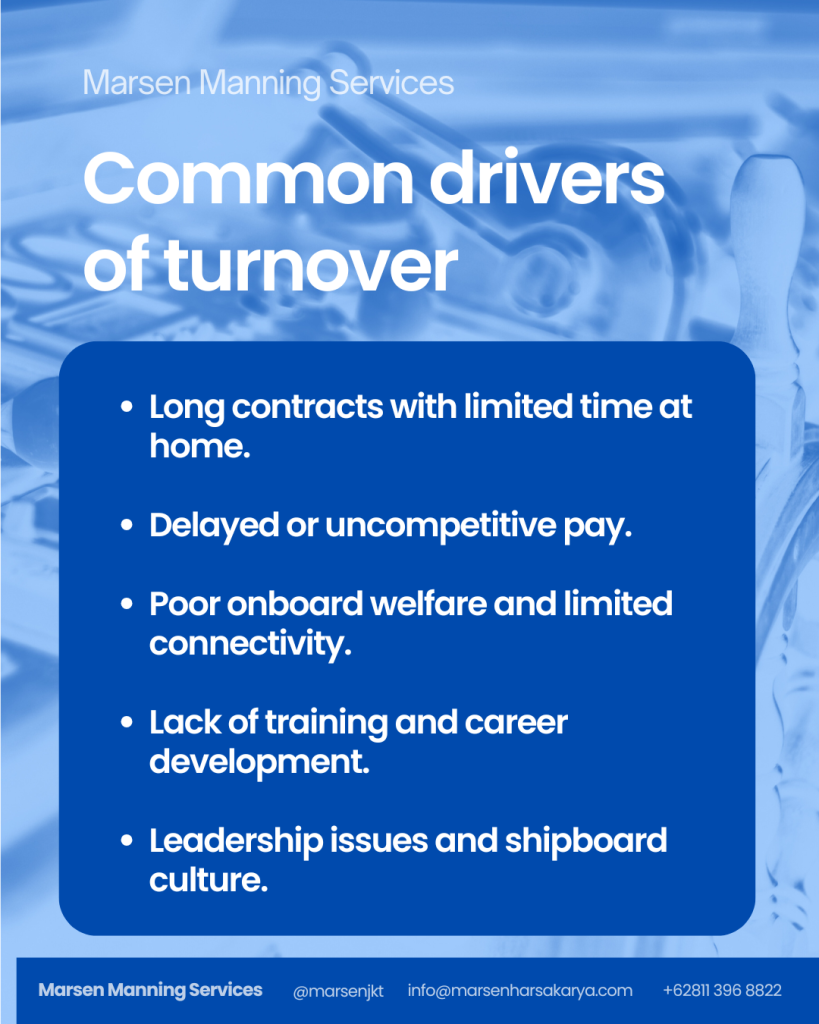
The Maritime Labour Convention (MLC) regulators set minimum standards for seafarers’ rights, but meeting the minimum doesn’t guarantee retention. Studies in Europe and Southeast Asia highlight the most common drivers of turnover:

In short, when seafarers feel undervalued, they seek better opportunities elsewhere. Replacement can be costly.

Western EuropeSoutheast AsiaGlobally
Danica’s 2024 survey found that despite salary increases, retention remains a major challenge for European ship managers.

Around 41% of crew managers reported improved retention after raising pay, showing that turnover is costly enough to justify significant wage hikes.
A 2021 Indonesian study, by Samosir et.al showed that when seafarers felt low job satisfaction or little company support, they were significantly more likely to leave. This translates into frequent replacements and higher costs for principals.Drewry’s Manning Annual Review & Forecast 2023/24 shows rising wages and tighter supply in officer ranks globally. These cost pressures are worsened by frequent turnover. That means the savings from retention are even greater.

What this means for you

Whether in Europe or Southeast Asia, turnover drains budgets. But the drivers differ. In Europe, pay is critical, while welfare and engagement are keys in the Southeast Asia. A professional manning partner, Marsen Manning Services can help you balance both to keep seafarers loyal and costs under control.

How A Professional Manning Agency Company Flips the Script

Partnering with a professional manning agency directly addresses these issues:

  1. Lower recruitment overheads: Marsen Manning Services maintain pools of pre-vetted seafarers, cutting hiring delays and costs.
  2. Better retention: Matching seafarers to the right roles and investing in welfare reduces turnover. European survey data shows higher pay and structured contracts improve retention.
  3. Improved welfare & compliance: Marsen Manning Services ensures MLC standards are met through timely pay, communication access, or fair leave.
  4. Training & development: in Southeast Asia, studies highlight that career progression is a major factor in keeping seafarers loyal. Professional manning includes training pathways that reduce attrition.
  5. Operational stability: Consistent, experienced seafarer mean fewer safety incidents, smoother audits, and more reliable operations.

Compensation, culture, and placement are not just nice to haves, they’re levers with measurable impact. The Indonesia study’s model explains 76.2% of the variance in retention based on placement, compensation, and culture.

Compare that with the cost of replacing an officer (averaging between $10,000–$20,000 or more depending on status and location). Investing in these retention levers is likely to pay off many times over.

Practical Tips to Cut Turnover Costs

  1. Partner with Marsen Manning Services that understand MLC standards and to ensure proper job-placement based on skills and experience.
  2. Foster a positive corporate culture: leadership training, good communication, fair reward systems.
  3. Keep compensation offerings competitive and transparent (salary, bonuses, health benefits).
  4. Create training and promotion tracks so seafarers see a future with the company.
  5. Monitor turnover and retention metrics, especially in the ranks and regions where placement or culture seem weak.

For merchant vessel owners and operators, seafarer turnover is one of the biggest hidden costs in a vessel operation. The study shows clearly that placement, organisational culture, and compensation are critical to retaining skilled seafarers.

At Marsen Manning Services, we specialise in providing professional manning solutions that safe shipowners money, ensure compliance with MLC standards, and build loyal, high-performing seafarers.

Ready to turn turnover from a cost centre into a competitive advantage?

Contact Marsen Manning Services today to build loyalty, efficiency, and long-term value.

We can help to maintain your vessel manning needs running smoothly and profitably.

References

  • Samosir, C., Maharani, A., & Burhanuddin, M. (2021). Measuring Factor Affecting Indonesia’s Seafarers Retention. Journal of Business Management Review, 2(7):470-482. ResearchGate
  • Drewry (2023/24), Manning Annual Review & Forecast.
  • Danica Crewing Specialists (2024), Seafarer Salaries and Retention Rates.